
Wheelchair-Accessible LGBT+ Holidays: What to Check Before Booking
Wheelchair-Accessible LGBT+ Holidays: What to Check Before Booking
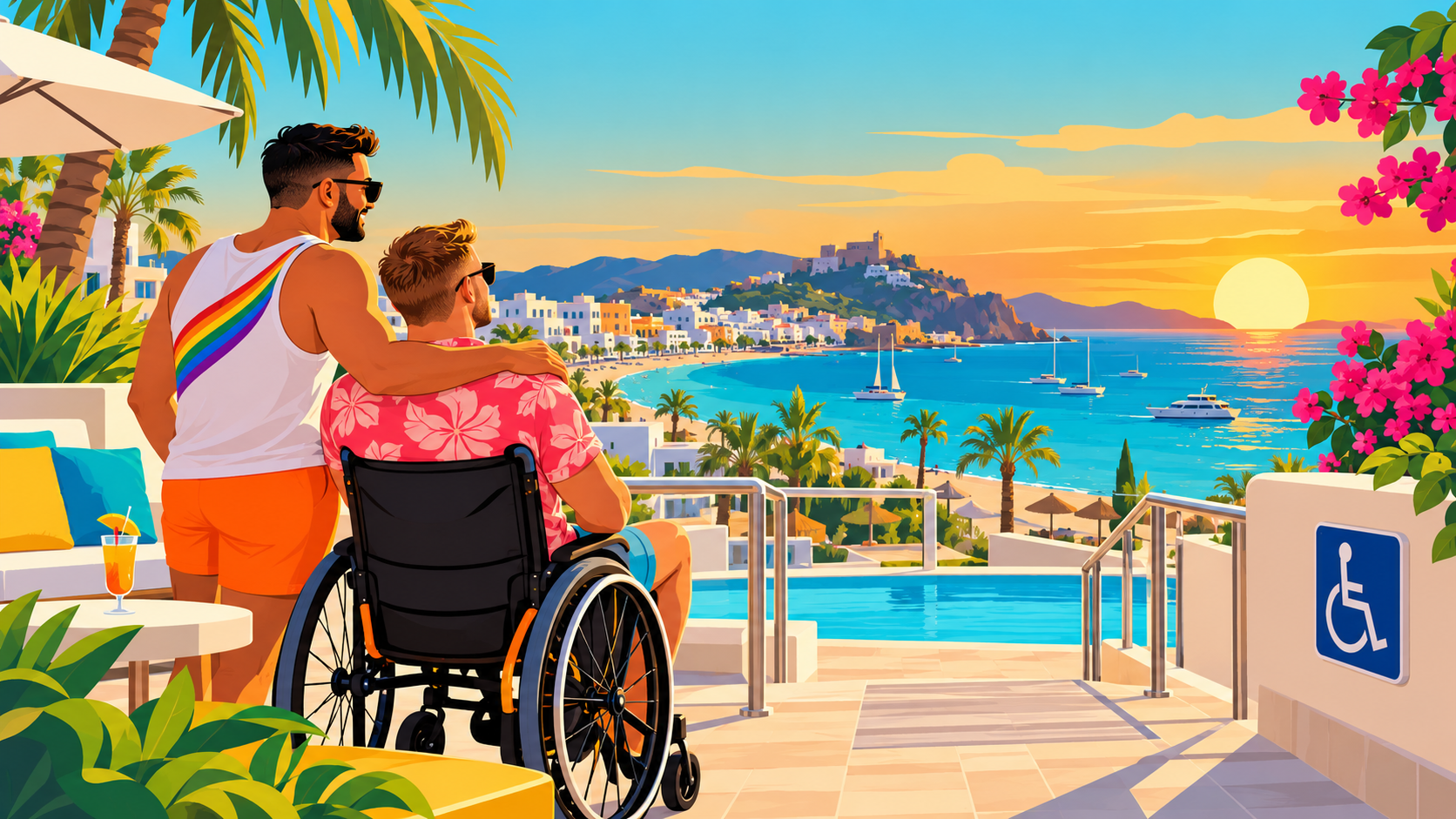
Wheelchair-accessible LGBT+ holidays should let you enjoy the experiences you actually want, not simply reach a hotel entrance. Yet a room can be labelled accessible without the right space beside the toilet. A welcoming Pride venue may have steps to its only toilets. And a private airport transfer may be a car that cannot safely carry your wheelchair.
This guide explains what to check before you commit to flights, accommodation, equipment, transfers and the LGBT+ experiences you are travelling for. It is written for UK-based wheelchair users, including people using manual or powered chairs, scooters or a combination of mobility aids. If you need a broader introduction to different access requirements, start with our accessible LGBT+ holidays guide.
Why Wheelchair-Accessible LGBT+ Holidays Need Two Checks
There are two separate questions behind a good booking. Can you reach and use the facilities and experiences? And will the accommodation, staff and local scene treat you as an LGBT+ guest with respect? One answer does not prove the other.
An LGBT+-owned hotel is not necessarily wheelchair friendly. Equally, a mainstream hotel may offer the right adapted room and a genuinely respectful welcome. Think about the holiday you want, whether that means a couple's beach break, a solo Pride trip, an accessible museum weekend or an inclusive cruise. Your priorities should shape the itinerary rather than being squeezed into a general 'disabled-friendly' package.
The promise that something is 'gay-friendly' can be too vague to mean much. You might want to know whether staff will respect a same-sex couple's shared bed, treat a trans guest sensitively or handle personal information discreetly. You also need practical answers about step-free access, equipment and bathrooms. Our gay holidays service starts with what the traveller needs and enjoys, not a guarantee that every property suits every wheelchair user.
Planning wheelchair-accessible LGBT+ holidays means looking beyond whether a destination welcomes LGBT+ visitors or a hotel advertises accessible rooms. You need to know whether your own wheelchair will fit, whether you can transfer safely, whether transport is suitable and whether the places you want to visit are genuinely usable.
Our existing guide to accessible LGBT+ holidays covers accessibility and inclusion more broadly. Here, we're concentrating on the physical measurements, mobility equipment, practical travel arrangements and supplier confirmations that matter specifically to wheelchair users.
Start With Your Chair, Not a Hotel's Accessibility Symbol
Before searching accommodation, write down the details you need suppliers to know. Include your chair's width, length and height, its weight, whether it folds and any detachable parts. If it is powered, include the make, model and battery type. Dimensions matter for aircraft loading, vehicle restraints, lift doors, narrow corridors and room layouts.
Next, describe how you transfer. Can you move independently into a bed or vehicle seat? Do you need a transfer board, help from a companion or a hoist? Do you approach the bed from a particular side? If you cannot use stairs even with help, say that clearly. If you can manage short distances without your chair, that may widen your choices, but it should not be assumed.
Separate your essentials from preferences. A roll-in shower, charging point and accessible airport transfer might be essential. A pool view might be a preference. If a key facility cannot be confirmed, you can reject the option before you have paid a deposit. The same applies to the particular concert, Pride event or attraction that motivates your trip.
Start With Your Wheelchair and Your Personal Access Requirements
Before comparing hotels, write down the details that affect how you travel. A manual wheelchair, powered wheelchair and mobility scooter can have very different dimensions and handling requirements. Two people using similar wheelchairs may also have completely different transfer needs.
Record your wheelchair's overall width, length, height and weight, including any equipment that cannot be removed. For powered chairs, note the make, model, battery type and manufacturer's handling instructions.
Then consider how you use your chair. Can you transfer independently? Do you need someone beside you?
Must you transfer from a particular side of the bed or toilet? Do you use a mobile hoist, standing aid or shower chair?
Separate your requirements into three categories: essential for safety or independence, important for comfort, and preferable but flexible. This makes it easier to compare alternatives without compromising on something you cannot manage without.
Do not assume that a wheelchair-accessible room suits everyone who uses a wheelchair. Suitability depends on the individual, their equipment and the layout of the actual accommodation.
Equipment hire and charging
Check whether hired hoists, shower chairs or other devices are actually suitable for you. Ask about the model, dimensions, delivery, collection, price, deposit and what happens if the equipment is unavailable or develops a fault. A mobile hoist needs sufficient floor space and access underneath the bed. A ceiling-track hoist must reach the areas you intend to use.
If you use an electric wheelchair, ask whether there is a safe place to charge it and whether local sockets and electricity supply suit your equipment. Do not assume the hotel will provide adapters, transformers or a secure storage area. Where you need medical equipment or medication storage, ask specific questions rather than relying on a hotel's general accessibility description.
How to Verify the Exact Hotel Room
The most useful phrase in an enquiry is 'the specific room available for my dates' . Some hotels have several adapted rooms with different layouts. A generic photograph or wheelchair icon cannot confirm what you will receive. Ask for current measurements, photographs or a floor plan of the bookable room and the route to it.
Why Measurements Matter More Than Accessibility Labels
An accessible room description rarely tells you everything you need to know. A doorway may look wide in a photograph but leave insufficient clear space when opened. A bathroom may have grab rails but not enough space to transfer from the side you need.
Ask the accommodation for the actual clear opening widths of doors, the usable floor space beside the bed and toilet, and the internal measurements of any lift you must use.
For the bathroom, confirm the toilet height, location of grab rails, shower entrance, shower-seat arrangement and usable transfer space. A walk-in shower may still have a raised edge, while a level-access shower does not automatically provide suitable turning space.
Request photographs or a floor plan of the particular room type being offered, ideally showing measurements.
If a supplier quotes a measurement, check whether it describes the clear usable opening rather than the width of the door itself.
There is no single room dimension that works for every wheelchair user. Compare the information supplied against your own chair and transfer needs rather than relying on a generic minimum standard.
Doorways, corridors and lifts
Begin at the vehicle drop-off. Is the way through reception, to the lift and along the corridor fully step-free? Are there thresholds, steep ramps, heavy doors or tight corners? Ask for clear doorway widths, lift door openings, internal lift dimensions and turning space. The clear opening can be smaller than the advertised door size once the door is open.
Compare the actual measurements with your chair and the space you need to manoeuvre. There is no single doorway measurement that guarantees suitability for everybody. Ask about long distances inside large resorts, accessible routes to shared facilities and what happens if a lift is out of order.
Bed height, transfer side and hoists
Ask the bed height, clear space on each side and whether furniture can be removed. If you need side access on a particular side of the bed, describe which side while facing the headboard. That avoids confusion over 'left' and 'right'. If you use a hoist, get the under-bed clearance and room turning dimensions, not just a statement that a hoist is welcome.
For couples, also check whether the confirmed room has a double bed or two singles. A hotel being welcoming to same-sex guests is no guarantee that the suitable adapted room has the preferred layout. Agree which requirement matters most before accepting alternatives.
Toilets and showers
'Walk-in shower' may still mean a raised lip. Ask if the shower is level access, whether a shower chair is available, where the controls are and whether the room accommodates your own shower chair. Get the toilet height, side-transfer space, grab-rail positions and any fixtures that obstruct manoeuvring.
A photograph showing only a shiny shower wall is not enough. Ask for an image that shows the doorway, toilet, shower and space between them. A room can be nominally adapted yet have insufficient room for a particular chair or transfer technique.
Beds, Hoists, Charging and Emergency Evacuation
If you use a mobile hoist, ask whether there is enough space to position and manoeuvre it beside the bed.
Check the clearance beneath the bed and whether the bed base prevents the hoist from moving into position.
For a profiling bed or hired hoist, confirm who supplies it, whether it is compatible with your sling or other equipment, whether the room can accommodate it and whether the accommodation accepts delivery.
Powered wheelchair users should also check suitable charging arrangements, the local electricity supply, plug types and any restrictions on storing or charging batteries indoors. Do not assume a hotel can provide an adaptor, transformer or suitable charging location.
Ask about emergency procedures too. An accessible bedroom on an upper floor may depend on a lift that cannot be used during an evacuation. Find out how the hotel plans to assist guests who cannot use stairs, where designated refuge areas are located and how alarms and instructions will be communicated.
These questions are especially important when a booking depends on mobility equipment or personal assistance arrangements that cannot easily be replaced.
Restaurants, pools, beaches and safety
Find out whether you can get to the restaurant, bar, terrace, pool and public toilets independently or with the assistance you have agreed. Some pools have a hoist, but using it may depend on staff availability. A beach boardwalk may end well before the water. Ask where it ends, whether beach wheelchairs are available and where the nearest usable toilet is.
Ask the hotel about its actual emergency evacuation arrangements, including refuge points or alarm methods relevant to your needs. If you are Deaf or hard of hearing, visual or vibrating alerts could matter. Be wary of any answer that simply promises staff will carry you downstairs without explaining the procedure.
Flying From the UK With a Wheelchair
Airline assistance and accommodation accessibility are separate arrangements. Request airport help at the time of booking where possible. The Civil Aviation Authority's guidance on assisted travel recommends giving notice when booking or at least 48 hours before travel if possible. Where notice is shorter, reasonable efforts should still be made, although there can be delays.
Describe the assistance needed from check-in through security, boarding, seating, connections and arrival. Check both outward and return journeys, particularly when using different airports or airlines. Ask when you must hand over your own wheelchair and when it should be returned. Your own chair is normally carried in the hold rather than the passenger cabin.
Powered chairs and airline acceptance
For a powered wheelchair, give the airline the make, model, dimensions in its smallest safe loading form, weight, battery chemistry and handling instructions. Airlines need this information to assess carriage on the particular aircraft. A change of aircraft can change what can be loaded, so reconfirm the arrangement if the itinerary changes.
Keep written instructions explaining how to isolate power, protect the controls and remove or secure vulnerable components. Photograph the wheelchair before handing it over. The CAA's mobility-equipment guidance explains why early equipment and battery information is important. Check the rules for spare batteries and medical equipment directly with the airline.
Flying With a Powered Wheelchair
An airline needs more information about a powered wheelchair than a simple request for assistance. Before committing to a flight, provide the make, model, dimensions, total weight and battery details.
Ask the airline to confirm whether the specific aircraft can accept the chair, including any limits caused by hold doors, loading equipment or handling arrangements. Aircraft on different legs of the same journey may have different restrictions.
Bring the manufacturer's handling instructions, including the correct process for isolating power, securing removable components and preparing the chair for transport. Do not disconnect equipment or remove batteries without checking the applicable airline and manufacturer instructions.
Take photographs of the chair before travel and consider a clearly attached handling-information sheet. Remove and carry detachable cushions or delicate components when permitted and practical.
Confirm arrangements for the outbound flight, connections and return journey separately. A wheelchair accepted on one aircraft is not automatically suitable for every other flight.
Aircraft toilets, aisle chairs and personal care
Ask whether an onboard aisle chair is available, what transfer assistance the crew can offer and whether the aircraft toilet will meet your requirements. An accessible toilet in an airport terminal does not mean the aircraft toilet is usable for your particular needs.
Cabin crew can help with moving towards a toilet but are not generally required to provide personal care, assistance using the toilet or medication administration. If you need that support, clarify companion requirements with the airline in advance. Allow realistic time for connections and check whether the smaller aircraft on a connecting flight has different restrictions.
Wheelchair Access Does Not Mean Every Aircraft Toilet Is Accessible
Airport assistance, boarding support and assistance on board are different services. A passenger may be helped into an aircraft seat without being able to use the aircraft toilet independently.
Ask whether the particular aircraft has an onboard aisle wheelchair, whether its toilet facilities meet your needs and what help cabin crew can provide.
Cabin crew may help a passenger move towards the toilet, but they are not generally expected to provide assistance with personal care, using the toilet, eating or taking medication. Travellers who require this support may need a suitable companion.
Discuss these requirements before booking, particularly for long-haul flights or journeys with connections. Do not assume that an aircraft described as modern or accessible will have a toilet configuration suitable for your individual needs.
What If Your Wheelchair Is Damaged During the Flight?
If your wheelchair arrives damaged, report the problem to the airline or its baggage-handling representative before leaving the airport wherever possible. Ask for a written incident record and keep photographs of the damage.
Explain immediately if the chair is unsafe or unusable. Ask what suitable temporary mobility equipment or assistance can be arranged and keep evidence of any essential additional costs.
Airlines have responsibilities when mobility equipment is damaged, although applicable compensation limits may not reflect the full replacement cost of an expensive powered wheelchair. Review your travel insurance and any additional equipment cover before departure.
Retain your boarding passes, equipment details and written correspondence. If the problem is unresolved, follow the airline's complaints procedure and the appropriate escalation route.
Confirm the Right Airport Transfer Vehicle
A 'private transfer' does not automatically mean a wheelchair-accessible transfer. Some travellers can transfer safely into a standard seat. Others need to remain in their wheelchair throughout the drive. Tell the transport operator which applies to you and ask for the right vehicle rather than a generic booking note.
Staying in Your Wheelchair During the Journey
A wheelchair-accessible vehicle must be suitable for the particular passenger and wheelchair, not simply advertised as adapted.
If you need to remain seated in your wheelchair, confirm that the vehicle has appropriate ramp or lift capacity, sufficient internal headroom and usable space for your chair. Ask what wheelchair securement and passenger restraint systems are provided.
If you transfer to a vehicle seat, the requirements may be different. Confirm how the transfer will be managed and whether any necessary equipment is available.
The operator also needs to know how many people are travelling and how much luggage and mobility equipment must fit inside the vehicle.
Check airport meeting arrangements, what happens following a delayed flight and whether an equivalent vehicle is confirmed for the return journey. Where adapted transport is essential, a standard private car should never be treated as an acceptable substitute without the traveller's agreement.
For occupied-wheelchair travel, confirm ramp or lift capacity, entrance dimensions, internal height, wheelchair position, appropriate restraints and seatbelt arrangements. Check whether the vehicle accommodates your chair's weight and size plus all travelling companions, luggage and mobility equipment. Ask whether drivers are trained to use the equipment and what assistance they actually provide.
Record the meeting point and emergency number for arrival, including what happens with a delayed flight. Repeat the checks for departure. If your holiday involves evening activities, ask about wheelchair-accessible taxis at the hours you will travel. Being able to reach a club during the day is little help if there is no safe way back to the hotel after midnight.
Choosing an LGBT+-Welcoming Destination With Usable Routes
A city's reputation for accessibility or LGBT+ culture is only a starting point. You need to check the specific neighbourhood, hotel and route. Cobbles, steep hills, beach sand, closed lifts and busy crossings can turn a short distance on a map into a difficult outing.
Barcelona and Sitges are examples worth researching for coastal LGBT+ trips. Before booking, check the actual beach approaches, the route from hotel to your chosen bars and the availability of suitable transfers. Amsterdam and Berlin may appeal for art, museums and nightlife, but historic buildings and station-by-station differences still need checking. Brighton might be attractive for a Pride weekend closer to home, yet the access arrangements for specific seafront venues and temporary event sites can change.
Gran Canaria can offer a different style of LGBT+ holiday, with resorts, beaches and nightlife. A hotel may be near a popular area on a map while the approach involves gradients or an unsuitable path. Check the exact route, not simply a claim that the wider resort is wheelchair friendly. These are illustrations of destinations to investigate, not a verified accessibility ranking.
Physical accessibility and LGBT+ treatment also vary within a destination. Consider local laws, public attitudes, public displays of affection and how trans or non-binary guests may be treated, including when travel documents are checked. A resort environment does not cancel national law. The FCDO's LGBT+ travel advice provides a UK starting point, alongside the current country-specific travel advice.
Explore our gay city breaks or gay beach holidays for ideas, then narrow the options to individual places and verified routes that work for your chair and priorities.
Compare the Routes You Will Use, Not Just the Destination's Reputation
Barcelona, Gran Canaria and Sitges illustrate why destination choice needs individual research.
Barcelona: Its metropolitan transport operator publishes accessibility information, including accessible route planning and lift status. That can help when researching journeys between accommodation, attractions and LGBT+ neighbourhoods. The exact stations and routes still need checking before travel.
Gran Canaria: The popular gay holiday areas around Playa del Inglés and Maspalomas offer a very different experience from a city break. Focus on the route from your hotel to the places you want to visit, including beaches, restaurants and nightlife. Sand, ramps, gradients and late-night adapted transport all deserve separate checks.
Sitges: A compact coastal destination may appeal to travellers who want beaches, cafés and an LGBT+ social scene close together. That does not mean every old-town street, entrance or beachfront venue will suit every wheelchair user.
The useful comparison is not simply which destination has the best reputation. It is which itinerary allows you to reach the hotel, venues and activities you actually want to enjoy.
Can You Access Pride, Nightlife and Gay Beaches?
The point of travelling may be to celebrate Pride, meet friends, watch a drag show or enjoy a particular beach. Those experiences deserve the same careful questions as your hotel room. Start with the organiser or venue's current access information, then ask about any details that remain unclear.
For a Pride event, check accessible entrance locations, viewing areas, toilets, companion policies, registration requirements and how the route connects with transport. Events may have accessible platforms but limited capacity or advance booking rules. Consider crowd density, shade, rest areas and a clear way to leave if needed.
For nightlife, verify the actual doorway and internal route. A bar might offer step-free entry to the ground floor but have inaccessible toilets or an upstairs performance area. Ask whether a lift is available for the whole event and whether a suitable vehicle can be pre-booked afterwards. A venue's inclusive marketing should never substitute for physical access details.
For beaches and pool clubs, check gradients, boardwalks, beach wheelchair hire, toilets, changing facilities, seating and pool-entry equipment. If special equipment needs staff, ask when trained staff will be there. Couples, solo visitors, older travellers and people who do not want nightlife deserve equally thoughtful planning. An enjoyable LGBT+ holiday is not defined by parties.
The Difference Between Getting Into a Venue and Enjoying It
Imagine booking a holiday around a Pride event. The organiser confirms a step-free entrance, which sounds encouraging. But you still need to know whether the viewing area provides an unobstructed view, whether an accessible toilet is available, how crowded access routes become and whether you can leave and return during the event.
The same applies to LGBT+ nightlife. A bar may have a level entrance but steps to the toilets. A club may have a lift but no suitable seating or wheelchair space near the entertainment.
Check the full experience rather than one accessibility feature. That includes arrival, toilets, drinks or dining, viewing areas, evacuation arrangements and transport home.
For outdoor Pride celebrations, ask whether accessible viewing spaces require registration and whether companion arrangements or entry conditions apply.
This is a hypothetical planning example, not a claim about a particular event or venue.
Wheelchair-Accessible Cruises, Tours and Group Trips
A ship may have accessible cabins yet still have inaccessible shore experiences. Ask for the actual cabin's door and bathroom dimensions, bed layout, charging arrangements, accessible restaurants and muster procedures. Embarkation gangways can vary with the port, ship and tide.
Tender ports are especially important. If passengers must take a small boat ashore, wheelchair access can be restricted even where the cruise ship itself is accessible. Confirm how many ports use tenders and which accessible excursions can be provided. Ask about transport, toilets and steps at every key attraction before selecting a sailing around must-see shore visits.
River cruise arrangements can be different again. Gangway angles, docking positions and access between vessels may vary. A specialist group or charter can provide a welcoming atmosphere without guaranteeing accessibility at every stop. Our LGBT+ river cruises in Europe guide compares hosted groups, charters and mainstream cruises, while the wheelchair-specific details still require separate supplier confirmation.
Accessible Ships Are Not the Same as Accessible Itineraries
A cruise ship may have wheelchair-accessible cabins, lifts, restaurants and entertainment spaces while still visiting ports that some wheelchair users cannot access.
Check whether the ship docks alongside a terminal or uses tender boats. Tender operations may be unsuitable for some wheelchair users, depending on equipment, the ship, local facilities and conditions on the day.
Ask whether the specific accessible cabin is available, what its bathroom layout provides, whether corridors and lifts accommodate your chair and how boarding arrangements work.
For shore excursions, check transport, walking surfaces, toilets, tour duration and whether mobility equipment can be carried.
Accessible cabins may be limited, so do not assume a standard cabin can be substituted if the original one becomes unavailable.
The same principle applies to LGBT+ escorted group tours. A welcoming group and attractive itinerary do not guarantee that every hotel, coach, attraction or scheduled activity is wheelchair accessible.
For escorted tours and small groups, ask whether the same adapted transport is available throughout and whether restaurants and attractions suit your chair. If one excursion is unsuitable, agree on a meaningful alternative in advance. A clear, workable itinerary is better than a promise to sort things out when you arrive.
What Might Cost Extra?
Accessible holidays are not automatically more expensive, but some requirements involve specialist services. Adapted vehicle transfers, equipment hire, a particular room category, personal assistance or a slower itinerary can affect the price. Availability of specialist vehicles and rooms may also be limited in peak periods.
Ask for an itemised quotation. Are both adapted transfers included? Does hoist hire include delivery and removal? Are there deposits or equipment damage charges? Could the supplier charge to amend a booking where essential facilities were only requested? A price comparison is meaningful only when you know that both quotes include the arrangements you need.
Travel insurance is different from airport assistance or financial protection. Review medical declarations, cancellation cover, existing-condition terms, mobility-equipment limits and any replacement-hire benefits. Check rules for carrying medication at your destination and where you change planes. Do not assume a standard policy covers damage to a high-value powered chair in full.
What Additional Costs Should You Budget For?
A wheelchair-accessible holiday does not necessarily need to be a luxury holiday, but some specialist arrangements can change the price.
Possible additional costs include suitable private transfers where none are included, locally hired hoists or shower equipment, accessible excursions, additional insurance cover and accommodation that can meet specific transfer requirements.
Do not assume that every accessibility-related service should attract a surcharge. Check what assistance or services are included in the original booking, what the relevant provider is required to offer and which extras are genuinely separate purchases.
Where equipment hire is necessary, obtain the full price, deposit arrangements, delivery and collection details, cancellation terms and information about replacement equipment if a fault occurs.
A written breakdown helps you compare the complete cost of suitable holidays rather than comparing headline hotel prices that exclude essential arrangements.
Confirm, Request or Leave Unverified: Know the Difference
Before paying a deposit, put each essential requirement in one of three categories. Confirmed means the supplier has accepted a particular service or facility for the booking. Requested means it has been asked for but is not guaranteed. Unverified means there is no reliable evidence either way.
What Does a Proper Accessibility Confirmation Look Like?
Consider three different responses to the same request.
Unverified: "The hotel is wheelchair friendly."
This gives no information about the exact room, bathroom, available space or whether the accommodation suits your needs.
Requested: "We have added your request for a roll-in shower to the reservation."
The requirement has been recorded, but this does not necessarily mean that the correct room has been secured.
Confirmed: "The hotel has confirmed the specified room category for your dates and supplied details of the bathroom layout, door access and required facilities."
This is more useful evidence, provided the information matches your requirements and forms part of the arrangements agreed with the relevant supplier.
Ask who provided the confirmation, when it was obtained and which booking or room it relates to. If an essential requirement remains unresolved, establish the position before accepting any payment or cancellation commitment.
Consider a traveller who needs a roll-in shower with clear transfer space on the right side of the toilet. 'Accessible room requested' does not establish either requirement. A useful confirmation identifies the room category, the actual layout and the dates for which it is reserved. If that evidence cannot be obtained, look at another room or hotel before making a financial commitment.
Keep dated written responses, photographs, room plans, airline equipment acceptance, transport specifications and any agreed alternative arrangements. Ask how changes would be communicated and who can help if a supplier later substitutes a facility. Terms concerning cancellation and amendment charges matter particularly when the booking depends on an essential feature.
Your wheelchair holiday evidence checklist
Use the following as your last review before authorising payment:
- Room route: entrance, corridors, lifts, clear doorways and turning space.
- Bed: height, correct transfer side, space for a companion or hoist.
- Bathroom: level-access shower, toilet height, rails and side-transfer clearance.
- Hotel facilities: step-free restaurant, pool, beach and accessible toilets.
- Flights: assistance on every leg, boarding procedure and equipment acceptance.
- Powered wheelchair: battery type, size, weight and handling instructions.
- Transfers: suitable vehicles, securement and return-journey confirmation.
- Activities: access to Pride venues, outings, beach facilities and late transport.
- Equipment: verified hire, charging, delivery and a backup plan.
- Respect: preferred room and bed arrangement, privacy and inclusive treatment.
- Terms: deposits, cancellation and any unverified essential requirement.
- Contingency: supplier contacts and realistic alternatives if plans change.
Use the following checklist to compare accommodation, flights, transfers, equipment and the LGBT+ experiences you want to enjoy. Some answers may be straightforward, while others will need measurements, photographs or direct supplier confirmation.
Treat it as a decision-making tool rather than a promise that every facility can be provided. Where a requirement is essential, record the answer and who confirmed it.
| Access requirement | Specific question to ask | Evidence to request |
|---|---|---|
| Bedroom door and route | What are the clear door openings, thresholds and corridor widths from entrance to my allocated room? | Current measurements and photographs of the actual room route |
| Lift | What are the lift's clear entrance width, internal depth and weight restrictions? | Lift specifications, plus any alternative access plan |
| Bed and transfers | What is the bed height, space on my required transfer side and clearance beneath the bed for my hoist? | Bed measurements and actual room layout |
| Bathroom | Is the shower truly level access, and what are the toilet height, side-transfer space and grab rail positions? | Current photographs, measurements and bathroom plan |
| Communal areas | Can I independently reach restaurants, pool, terrace, beach and toilets without unusable steps? | Step-free route description and access photographs |
| Airport assistance | Is assistance booked for each airport, connection, outbound and return flight? | Written airline assistance confirmation |
| Powered wheelchair | Will my chair's packed dimensions, weight and battery type be accepted on each aircraft? | Airline approval and handling instructions |
| Airport transfers | Can the vehicle carry my chair occupied, with suitable lift/ramp, restraints and luggage space? | Written vehicle specifications and two-way booking confirmation |
| Pride and nightlife | Is there step-free venue access, an accessible toilet, suitable viewing area and a workable journey home? | Current event or venue accessibility confirmation |
| Cruise or organised tour | Are my cabin, boarding route, ports, shore excursions and group vehicles suitable? | Written operator confirmation for each essential segment |
| Hire and charging | Is necessary hoist/medical equipment available and is safe chair charging possible? | Supplier hire confirmation, equipment model and power details |
| LGBT+ welcome | Does the property respect couples, gender identity, privacy and individual communication preferences? | Current property policy or specific written reply |
| Unresolved requests | Is each essential need confirmed, merely requested, or still unverified? | Itemised supplier confirmations and booking terms |
| If plans change | Who handles a room mismatch, wheelchair damage, failed transfer or inaccessible excursion? | Emergency contacts, escalation process and applicable conditions |
When the Arrangements Do Not Match What Was Confirmed
If you arrive and the promised room or equipment is not available, explain precisely which feature is missing. Contact the accommodation and the holiday provider promptly. Share the written agreement and ask for a suitable remedy. An alternative room is not equivalent if its door is too narrow or its toilet lacks the required transfer space.
If an adapted transfer fails, contact the transport supplier and travel provider before arranging an alternative where practicable. Keep receipts and a record of the problem. If a wheelchair is damaged during a flight, report it to the airline quickly, photograph the damage, keep your equipment documentation and ask about a suitable temporary replacement.
Your options depend on the booking terms, who made the promise, the type of package or separate travel services and applicable law. Not every accessibility failure produces an automatic full-refund right. The important starting point is an accurate written record and clear escalation to the responsible provider.
Jamie Says:
"A hotel calling a room accessible is not enough for me to recommend it to someone with specific transfer or bathroom needs. I'd rather ask awkward questions before booking than leave someone facing an avoidable problem on the first night of their holiday."
Jamie Wake

What If an Essential Accessibility Arrangement Goes Wrong?
Even carefully checked travel arrangements can change. The important question is how quickly a problem can be identified and addressed.
If you arrive at a hotel and the confirmed room is unsuitable, explain exactly which essential facility is missing. Contact the hotel and the relevant tour operator or travel organiser promptly, preferably while the problem can still be addressed.
Keep copies of the original confirmation and take photographs where appropriate. Ask for an alternative that meets your actual requirements rather than automatically accepting any room described as accessible.
If an adapted transfer fails, contact the provider and relevant booking support team before arranging replacement transport where practical. Explain immediately if remaining in your wheelchair is essential for safe travel.
For wheelchair damage, report the issue to the airline and ask about suitable temporary arrangements.
Keep records of the people contacted, proposed solutions and reasonable additional expenses. Your remedies will depend on the circumstances, contract and applicable law. Not every accessibility problem automatically entitles a traveller to a full refund.
Financial Protection and What It Does Not Cover
Wide Awake Holidays is a specialist LGBT+ travel division of Wake Enterprises Limited, alongside our sister company, Jamie Wake Travel, with the applicable booking terms and financial protection explained before confirmation.
We are a member of Protected Trust Services, membership number 6266, and holds ATOL 12759. ATOL protection applies to eligible flight-inclusive arrangements, with an ATOL Certificate issued where applicable.
Other eligible tailor-made arrangements may include Supplier Failure Insurance or Scheduled Airline Failure Insurance, depending on the booking structure and the cover arranged. Not every travel service receives the same protection.
Financial protection should not be confused with travel insurance, compensation for damaged mobility equipment or a guarantee that a particular hotel's facilities will be suitable. Travellers should check the specific protection that applies to their own booking.
Plan the Holiday You Want, With the Checks You Need
Tell us the holiday you want, not just the equipment you use. Whether you are planning a beach break, a Pride weekend, a city escape or a cruise, the starting point is understanding which arrangements will allow you to enjoy it.
Wide Awake Holidays can discuss your priorities, compare potentially suitable suppliers and seek more detailed information about accommodation, transport and other travel arrangements. Where a requirement is essential, we will explain what has been confirmed and what still needs checking.
Sometimes gay-friendly is not friendly enough. And sometimes wheelchair accessible is not detailed enough either. Both deserve proper questions before you book.
Call 01495 400947 or use our Wide Awake Holidays contact form. Tell us the experiences you want and the arrangements that are essential. You do not need to start by explaining a diagnosis.
Frequently Asked Questions About Wheelchair-Accessible LGBT+ Holidays
Can I travel abroad with an electric wheelchair?
Often, yes, but the airline must be able to accept the particular chair and its battery. Provide the make, model, full dimensions, weight and battery details before committing to the flight. Check each aircraft on the itinerary, including connections.
How do I know whether a hotel room will work with my hoist?
Ask for bed clearance, transfer space, doorway measurements and a layout showing where the hoist can move. If equipment is being hired, confirm the exact model, compatibility, delivery arrangements and hotel acceptance before booking.
Can I stay in my wheelchair during an airport transfer?
Yes, in a suitably equipped vehicle, subject to the particular chair and vehicle being compatible. Ask about the ramp or lift, space inside the vehicle, wheelchair securement and passenger restraint system. A standard private transfer is not necessarily suitable.
Are aircraft toilets wheelchair accessible?
Facilities vary by airline and aircraft. Some have onboard aisle wheelchairs, but using the toilet may still be difficult or impossible for some travellers. Check the particular flight and the assistance available before booking.
What happens if an airline damages my wheelchair?
Report the damage promptly, ideally before leaving the airport. Obtain a written record, keep photographs and contact the airline about repair, suitable temporary equipment and any claim. Check your insurance because compensation limits may not cover the full cost of replacement.
Are gay cruises suitable for wheelchair users?
Some cruise ships offer adapted cabins and accessible facilities, but this does not guarantee every port or shore excursion is accessible. Check the specific cabin, boarding arrangements, tender ports, transport and excursions before paying a deposit.
How can I check whether a Pride event is wheelchair accessible?
Contact the organiser for information about step-free access, viewing areas, accessible toilets, seating and any advance registration. Check transport to and from the event and whether access arrangements can change because of weather or crowd management.
What if a hotel only offers an accessible room as a request?
Treat it as unconfirmed unless the supplier confirms the specific essential facilities for your booking. Ask whether a suitable room can be secured, and review the booking and cancellation terms before paying.
Do wheelchair-accessible LGBT+ holidays cost more?
Not necessarily. Costs depend on the destination, accommodation and arrangements needed. Some assistance is included, while specialist transfers, equipment hire or excursions may create additional expenses. Ask for an itemised price covering the services that are essential to your holiday.
About Jamie Wake
Jamie Wake is the founder of Wide Awake Holidays and Jamie Wake Travel, helping UK travellers plan inclusive holidays where they can feel genuinely welcome, comfortable and confident.
Jamie combines personal experience with professional travel-industry knowledge to help travellers compare destinations, hotels, resorts and holiday experiences more carefully. His approach looks beyond labels such as “gay-friendly” to consider how inclusive and welcoming a destination or property is likely to feel in practice.
Through Wide Awake Holidays, Jamie shares practical, honest guidance about LGBTQ+ travel, inclusive destinations and choosing holidays that suit each traveller - not simply the option with a rainbow in its marketing.
Some of our Latest Offers
Discover our latest hand-picked travel offers below – automatically updated and inspired by the destinations featured in this blog.