
Gay Travel in Seoul: Neighbourhoods, Nightlife and Practical Advice
Gay Travel in Seoul: Neighbourhoods, Nightlife and Practical Advice
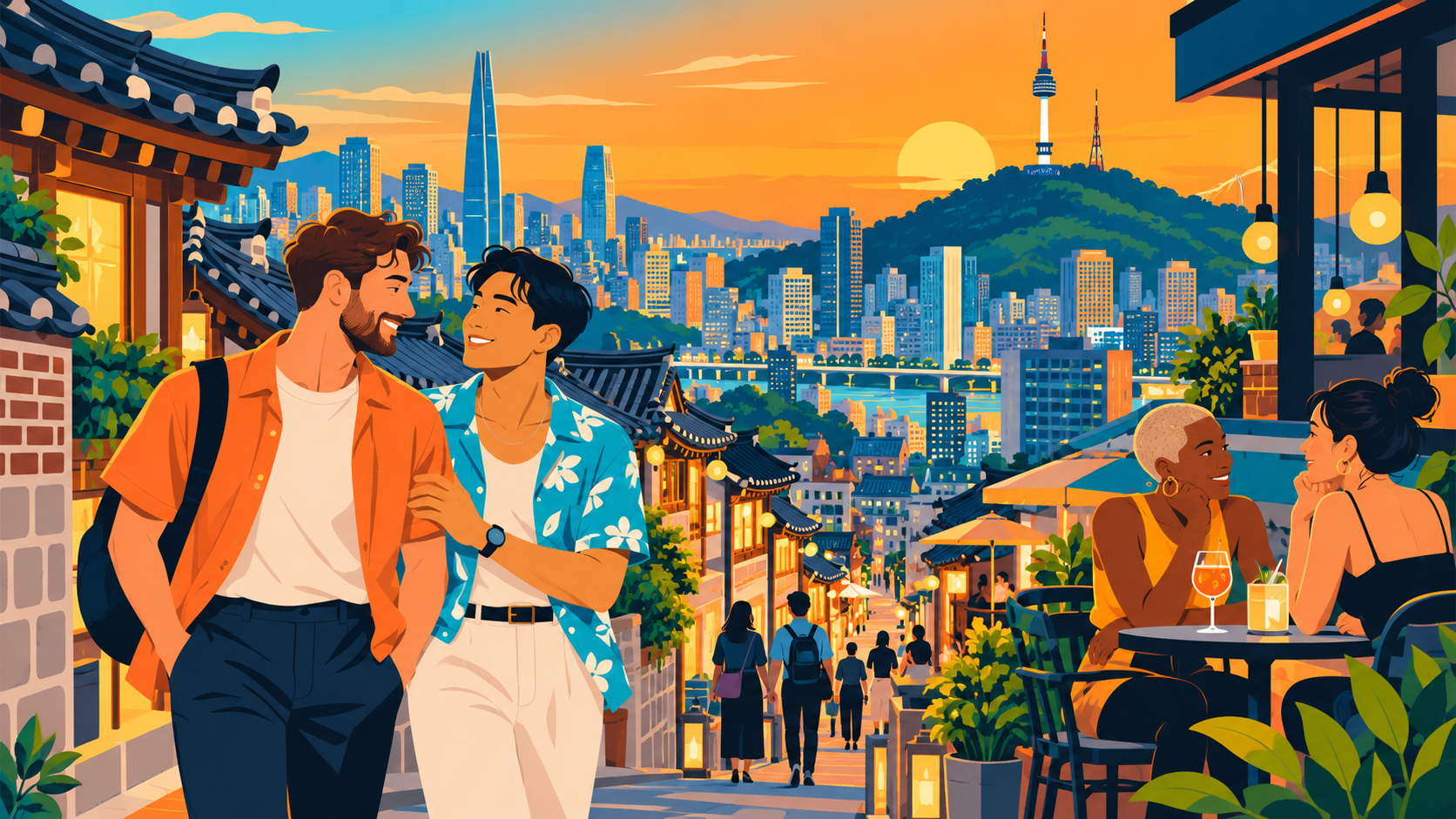
Gay travel in Seoul is not just about finding a bar in Itaewon. It is about knowing where different parts of the LGBT+ scene meet, choosing a comfortable base and understanding the gap between South Korea's growing queer visibility and its legal protections. This guide is for UK travellers who want the city's food, palaces, neighbourhoods and late nights, with practical advice that takes their identity seriously.
Seoul can offer an absorbing city break whether you are travelling with a partner, friends or alone. But it is not one enormous gay district. Its nightlife is spread between areas with different audiences and customs. Start by deciding what kind of holiday you actually want, rather than assuming that being close to the busiest club is always best.
Gay Travel in Seoul: What to Expect
Seoul pairs excellent public transport and a huge range of culture with a queer scene that is sometimes visible and sometimes deliberately discreet. Itaewon has long been the easiest introduction to international-facing gay nightlife. Jongno 3-ga offers a more local gay bar culture. Hongdae and Sangsu have spaces and events that can appeal to queer women and mixed LGBT+ crowds. None of these neighbourhoods represents every LGBT+ resident.
The city is particularly rewarding if you enjoy exploring on foot, eating at different times of day and contrasting historic neighbourhoods with modern Seoul. A long weekend is enough for a first taste. Five or six nights gives you room for museums, shopping and evenings out without racing between them.
For travellers researching gay holidays further afield, Seoul is an example of why destination knowledge matters more than a simple 'gay-friendly' label. You'll have more fun when the plan reflects your interests, and fewer awkward surprises when accommodation and nightlife details are checked in advance.
How LGBT+ Friendly Is Seoul?
The law and the lived experience are different questions
Consensual same-sex relationships between civilians are legal in South Korea. Same-sex marriage and civil partnerships are not recognised, and South Korea still lacks a comprehensive national anti-discrimination law covering sexual orientation and gender identity. A 2024 Supreme Court ruling extended certain national health insurance dependent benefits to same-sex partners, but that is not equivalent to legal marriage recognition. Separate rules under military law continue to criminalise consensual same-sex conduct involving military personnel.
Transgender people in South Korea can obtain legal gender recognition, but the process involves significant legal and medical barriers. Protections against discrimination are also inconsistent. Some individual rights have been established through court decisions, but those rulings do not amount to comprehensive national equality legislation.
For visitors, the distinction matters because a destination's legal recognition of gender identity, the treatment of same-sex relationships and the attitude of an individual hotel are separate questions. A positive experience in Seoul should not be mistaken for evidence that everyone enjoys equal legal protection.
These distinctions matter, but they do not tell you how every person or hotel will treat a visitor. Seoul has visible campaigners, film festivals, community spaces and Pride events. It also has more conservative social expectations than many UK travellers may be used to. Acceptance can vary with setting, generation and individual attitudes.
Couples, public affection and privacy
A same-sex couple can plan a rewarding holiday in Seoul, including sharing a double room. The sensible check is whether a chosen hotel understands and will honour the requested bed arrangement, not whether a promotional webpage uses a rainbow symbol. Public displays of affection are relatively restrained in many settings, including among opposite-sex couples. In some areas, two men or two women holding hands may receive attention.
Privacy is especially important around local queer nightlife. A person who is comfortable speaking to you in a bar may not want their face posted online. Ask before taking photographs, avoid filming entrances or other guests and do not expose someone's identity through social media.
What about trans and non-binary travellers?
Do not assume that a venue's LGBT+ branding says anything definitive about its admissions policy, toilets or awareness of gender diversity. Ask accommodation providers about names, documentation, room arrangements and accessibility where relevant. Travellers whose appearance or identity documents may be interpreted differently should review the current FCDO guidance for LGBT+ travellers alongside entry rules.
It is possible to be excited about the city without pretending its equality framework matches the UK's. That honest perspective is more useful than either promising universal acceptance or treating the whole destination as unsafe.
Seoul's Gay Neighbourhoods: Choose Your Kind of Evening
Seoul's LGBT+ scene makes much more sense when you understand the geography. Itaewon, in Yongsan-gu, is an established international nightlife area. Jongno 3-ga is a different experience, with smaller local establishments and often less obvious signage. Hongdae and neighbouring Sangsu are known more widely for student culture, music and independent venues, including some queer women's and mixed events.
Haebangchon, close to Itaewon, has independent bars and an alternative atmosphere, but it is not a dedicated gay village. Gangnam and Nonhyeon have dispersed nightlife and sauna options rather than a continuous gay street.
| Neighbourhood | Atmosphere | Best For | LGBT+ Scene | Nearest Useful Station | Main Consideration |
|---|---|---|---|---|---|
| Itaewon and Homo Hill | International-facing gay bars, clubs and drag nights | First-time gay visitors and late nightlife | Established gay male nightlife cluster | Itaewon (Line 6) | Slopes, weekend noise and changing venue details |
| Jongno 3-ga | Smaller, more discreet local bars, food and karaoke | Conversation-led evenings and cultural sightseeing | Longstanding local gay male social scene | Jongno 3-ga (Lines 1, 3, 5) | Korean language, discreet entrances and individual entry policies |
| Hongdae and Sangsu | Music, youthful nightlife and independent spaces | Mixed events, queer women and younger visitors | Selected lesbian and mixed LGBT+ venues and events | Hongik University / Sangsu | Not a continuous gay district; check event dates |
| Haebangchon | Independent bars in a hilly area | Alternative evenings near Itaewon | Some mixed queer-friendly venues | Noksapyeong (Line 6) | Steep streets; not a dedicated LGBT+ district |
| Gangnam and Nonhyeon | Dispersed upmarket and late-night venues | A specific booked or verified venue | Individual venues rather than a walkable scene | Nonhyeon / Sinnonhyeon | Distances and admission conditions vary |
| Insadong / central Seoul | Culture, markets and convenient hotels | Couples and sightseeing-focused first-time visitors | Close to Jongno nightlife, not itself a gay village | Anguk / Jonggak / Myeongdong | Travel to Itaewon for its main gay club scene |
If nightlife is your priority, stay near the area where you expect to spend most evenings. If museums and restaurants matter equally, central Seoul can offer a better base and a short journey to the scene. Always check both the map and the terrain: a property labelled 'Itaewon' can still involve a steep uphill walk.
Itaewon and Homo Hill: The Most Visible Gay Nightlife
What is Homo Hill?
Homo Hill is the informal nickname for a cluster of gay nightlife around a sloping street near Itaewon. The surrounding scene extends beyond that one lane, so an old map showing a single strip may miss newer venues. Itaewon Station on Subway Line 6 is a useful reference point, but follow the venue's current map pin rather than an assumed exit.
This is often the more straightforward area for international visitors on a first night. You're more likely to find venues accustomed to overseas guests, English spoken alongside Korean and music spanning pop, K-pop and dance tracks. Drag, themed events and club nights may be part of the calendar, although schedules change.
Gay bars in Itaewon worth knowing about
For a specific starting point, MICHIN SEOUL occupies the former Queen bar premises at 7 Usadan-ro 12-gil, on Homo Hill. Its music-led atmosphere and combination of local regulars and international visitors make it worth considering if you want a busy gay bar rather than a quiet cocktail lounge. Its published schedule concentrates on late evenings towards the end of the week, so check the latest information before setting out.
Another established name is Eat Me, at 8 Usadan-ro 12-gil, which offers a smaller bar experience. If dancing is the main attraction, look for the current programme of dedicated clubs rather than assuming every establishment on Homo Hill has a dance floor.
Be careful with older guides. SOHO and the original Pulse have closed, while Queen moved away from its old Homo Hill location. Kockiri has also undergone changes to its operating arrangements. A name appearing in several online articles is not proof that the venue is still operating at the same address.
These examples give you somewhere to begin researching. They are not a guarantee of admission, a particular atmosphere or unchanged opening hours.
How to plan an evening
Start with dinner somewhere nearby rather than travelling across Seoul after midnight. Choose one verified bar as a starting point and one alternative within a manageable distance. Confirm opening times on official social accounts that day. Some venues open only on selected nights, have admission policies or operate much later than a UK pub.
Bring acceptable identification and expect the possibility of entry charges. Do not rely on an old article's quoted cover charge, drink price or closing time. Save your hotel address in Korean and check how you will get home before the last Metro service.
The timing is worth understanding. On a typical weekend, Jongno's smaller bars are more likely to attract an evening crowd, often from around 7pm or 8pm. Some Itaewon gay clubs do not become particularly busy until after midnight, with peak activity sometimes between 1am and 3am. These are general patterns rather than guaranteed opening times.
As an illustration of local spending, some Itaewon clubs have advertised entrance charges around ₩10,000, sometimes including a drink. Special performances may cost more, and certain Jongno venues use minimum food orders instead. Allow separately for drinks, late-night transport and any event tickets. Prices and conditions change, so confirm the actual charge before entering.
There is no reason to start every evening after midnight. A meal, one comfortable bar and an easy journey home can be a better introduction to the scene than a long night of unfamiliar clubs.
Itaewon suits first-time visitors, friends who want an upbeat evening and anyone who values an international atmosphere. It may suit you less if your ideal night is a quiet conversation or if you dislike steep streets and crowded late-night venues.
Jongno 3-ga: Seoul's More Local Gay Bar Scene
Jongno 3-ga has a different rhythm. Its gay scene has long been associated with smaller bars, conversation, food, karaoke and local regulars. It is less visually obvious than Homo Hill, and many establishments occupy upper floors or have discreet entrances. That is part of the area's character, not necessarily a sign that you have the wrong address.
Some venues have a largely Korean-speaking clientele. Others welcome international visitors, but this cannot be assumed from a pin on a map. Checking current reviews, Korean names and entry details can save an uncomfortable journey. A respectful greeting and willingness to follow the venue's guidance will help more than treating it as a tourist attraction.
Where should a first-time visitor start in Jongno?
Friends, often called Bar Friends, is one possible starting point. Located in the Nagwon-dong area near Jongno 3-ga Station, it is a longstanding gay bar with a reputation for relaxed conversation, cocktails and welcoming a varied clientele, including international visitors.
Its atmosphere is different from a late-night dance club. You are more likely to settle into a conversation than spend the evening moving between dance floors.
Some smaller Jongno establishments operate with minimum food orders or different expectations for regulars and new visitors. Ask what you need to order before sitting down. An English-friendly bar is a useful first stop if you do not speak Korean, but that does not mean other local venues are necessarily unwelcoming.
Jongno is attractive for travellers who prefer smaller-scale social evenings or want to experience a different side of Seoul's gay community. It also pairs well with daytime visits to Insadong, palaces and traditional restaurants.
There is no need to decide that one neighbourhood is 'better'. They serve different preferences. A first-time visitor might spend Friday in Itaewon and Saturday in Jongno, then decide where they feel most comfortable. A quieter evening followed by a taxi home can be every bit as worthwhile as a club night.
LGBT+ Nightlife Beyond the Main Gay Districts
Hongdae and neighbouring Sangsu are particularly important for travellers interested in queer women's nightlife and mixed LGBT+ spaces. Unlike Itaewon's more visible concentration of gay male clubs, these experiences are spread across individual bars, cultural spaces and event nights.
LesVos, near Sangsu, is a longstanding queer community bar associated with Seoul's lesbian history. It offers food and drinks in a more conversational setting, making it a different experience from a late-night nightclub. Its community significance has also been explored through Korean documentary work about lesbian spaces.
Ambition is another name associated with lesbian nightlife in the Hongdae area, particularly dancing and music. Its current events and admission arrangements should be checked directly before planning a visit.
Not every venue is intended for the same audience, and some community spaces keep their exact locations relatively private. Respect those decisions rather than circulating addresses from unverified directories. For visitors who want to explore this side of Seoul, researching current public events is often more useful than searching for a single dedicated lesbian district.
Haebangchon is worth exploring for independent bars and its hillside neighbourhood feel. It is an appealing extension of an Itaewon evening, not a substitute for the city's established gay districts. Travellers interested in drag or community arts may find specific event nights more relevant than the postcode itself.
One particularly relevant example is Rabbithole Arcade Pub, at basement level, 37 Sinheung-ro, in Haebangchon. Its programme combines drag, karaoke and other performances with a sociable bar atmosphere. It has been covered in local Korean news and is known for welcoming a mixed LGBT+ audience.
If you are visiting specifically for a drag show, check the dated programme rather than relying on normal bar opening times. Some performances have a separate entrance charge, and arriving early may help you find seating.
The venue's basement location also makes it important to check access arrangements if you have mobility requirements.
Gangnam and Nonhyeon are geographically dispersed. They are not an obvious first choice for someone hoping to walk between several queer venues. Visit a specific, verified establishment rather than expecting to arrive in a recognisable gay quarter.
For lesbian, bisexual, trans and non-binary travellers, an event-based approach may be more useful than following lists of 'gay bars' primarily written for men. Search organisers' current event pages and public venue accounts. Avoid sharing private event addresses or membership details without permission.
Bars, Clubs, Saunas and Respectful Nightlife Planning
Seoul has more than one kind of night out. There are conversation-led bars, karaoke rooms, dance clubs, drag events and some adults-only spaces. A mainstream Korean jjimjilbang is a traditional bathhouse or spa, not automatically a gay cruising venue. Do not confuse the two when choosing a place to relax.
Admission rules can vary by venue, age, gender, nationality, membership and event. A listing that says 'gay-friendly' does not promise unrestricted access. If a policy matters to you, confirm it directly and consider a second option.
This is particularly important for mixed-gender groups. Some gay male clubs have men-only admission policies or restrictions on women entering without a male guest. Other venues welcome a broader LGBT+ audience. Do not assume that an entire district follows one policy.
Some clubs may ask for original photographic identification and may refuse a photograph stored on your phone. Check the venue's requirements before travelling, and take care to keep your passport secure if you need to carry it.
Smoking restrictions and actual conditions inside nightlife venues are another consideration. Indoor smoking is legally restricted, but enforcement and individual behaviour may not always match expectations. If you are sensitive to smoke, crowds or loud music, check the setting before choosing a basement club.
Privacy and consent deserve particular care. Never photograph other customers without permission. Be cautious about meeting someone from an app in an unfamiliar venue. Arrange the first meeting somewhere public, tell a trusted person where you are going and protect personal information.
A useful first-night checklist is simple: one verified venue, one alternative, identification, a charged phone, a saved Korean-language address and a late-night transport plan. Check whether your accommodation has a reception desk or late-entry rules. Avoid leaving the whole return journey to chance.
For practical travel technology beyond Seoul, see our guide to essential LGBT+ travel apps. Apps can assist, but they cannot replace local information or personal judgement.
Where to Stay for a Gay Holiday in Seoul
Itaewon: for nights out on foot
Staying in or near Itaewon means you can return from its bars without crossing the city. The trade-off may be weekend noise, busy streets and steep slopes. Check the actual walking route to your hotel, not just the distance in a straight line.
Jongno and Insadong: for culture and local bars
This is an excellent compromise for travellers who enjoy sightseeing by day and smaller gay bars at night. You can reach historic attractions and restaurants easily. Accommodation ranges from simple guesthouses to apartments and hotels, but room size and sound insulation can vary.
Hongdae: for music, independent venues and younger crowds
Hongdae works well for visitors who want lively general nightlife alongside queer event nights. Airport rail links are another advantage. It is not the most practical base if you expect to spend every evening on Homo Hill.
Myeongdong and central Seoul: for first-time sightseeing
Central hotels put shopping, transport and major visitor attractions within easy reach. You can travel to Itaewon or Jongno when you choose rather than basing the whole stay around nightlife. This may suit couples, older travellers or anyone mixing culture with occasional evenings out.
If you are weighing Seoul against other destinations, our gay city breaks page can help you think about travel style before deciding on a hotel.
Three LGBT+-Relevant Accommodation Options to Consider
Seoul has an active LGBT+ nightlife scene, but it does not offer the same established choice of dedicated gay-only hotels and resorts as destinations such as Gran Canaria.
That makes it especially important to distinguish between three types of accommodation: a stay hosted through an LGBT+-focused platform, a mixed hotel or guesthouse with evidence of inclusive practices, and a property specifically operated for LGBT+ guests.
The following examples illustrate different ways of approaching accommodation in Seoul. None has been verified as an exclusively LGBT+ resort, and individual booking conditions must be confirmed before making a recommendation.
Sweet House, near Seoul Station
Sweet House is a private-room stay hosted by Ian through the LGBT+-focused misterb&b platform. The current listing describes a central position near Seoul Station and Sookmyung Women's University Station, with easy connections to Itaewon and other neighbourhoods. Recent guest reviews highlight the personal hosting experience. It could suit a solo traveller or couple who values local advice and a quieter residential base.
It is a hosted private accommodation, not a purpose-built LGBT+ hotel. The host notes that the property may not suit wheelchair users. Check whether the host will be present, the precise room arrangement and the cancellation conditions.
G Guesthouse Itaewon
G Guesthouse is a mixed-guest hostel or guesthouse that appears in specialist gay-travel accommodation listings. Its main advantage is location: Itaewon's nightlife is within walking distance. Dormitories and private rooms have been advertised, making this a possible option for budget-conscious visitors or friends.
It is not an exclusively gay property. Verify current room types, shared facilities, accessibility, opening status and quiet-hours expectations before making a booking. A private room may suit a couple better than a dormitory.
Private LGBT+-Hosted Accommodation Near Itaewon
Travellers who prefer a more personal experience could consider the private room advertised by Marco through misterb&b, under the listing "Private room in shared apartment in the heart of Seoul (Itaewon)".
The accommodation is in the Bogwang-dong area, convenient for exploring Itaewon's nightlife. The listing describes a private bedroom with a double bed within a shared apartment, rather than a conventional hotel room.
Guest feedback includes a stay from February 2026, providing a more recent indication of the accommodation experience than some older hotel-directory listings. However, the host's published response rate is relatively low, so availability and the details of the stay would need to be confirmed well in advance.
This option may suit an independent traveller or couple who wants a local residential setting close to the gay scene. It would not suit someone expecting hotel reception services, a dedicated LGBT+ resort or guaranteed sole use of an entire apartment.
| Property | Accommodation Type | Location | May Suit | Current Evidence | Important Caveat | Research Source (editor only) |
|---|---|---|---|---|---|---|
| Sweet House (Near Seoul Station) | Hosted private room on LGBT+-focused platform | Near Seoul Station / Sookmyung Women's University Station | Solo guests or couples wanting personal local advice | Current misterb&b listing; October 2026 guest reviews | May share property with host; not wheelchair-suitable according to listing | https://www.misterbandb.com/rooms/679952 |
| Private room in shared apartment in the heart of Seoul (Itaewon) | Hosted private room on LGBT+-focused platform | Bogwang-dong / Itaewon | Couple or solo traveller wanting a simple base near queer nightlife | Current misterb&b listing; February 2026 guest review | Host response rate is limited; confirm dates and room arrangements | https://www.misterbandb.com/rooms/857255 |
| G Guesthouse Itaewon | Mixed hostel/guesthouse with specialist LGBT+ travel approval listing | 14-38 Bogwang-ro 60-gil, Yongsan-gu | Budget visitors wanting proximity to Itaewon clubs | Travel Gay approved listing and accommodation's active information channel | Not gay-only; verify private rooms, shared facilities and availability | https://linktr.ee/gguesthouse |
What should LGBT+ travellers confirm before booking a Seoul hotel?
Before choosing accommodation, it is worth checking more than the photographs and neighbourhood.
For a same-sex couple, confirm the requested double-bed arrangement and whether the room will be prepared accordingly. If privacy matters, ask about check-in procedures and whether a shared apartment involves a resident host or other guests.
For trans and non-binary travellers, clear communication about booking names and identity documents can help avoid unnecessary confusion at reception. Anyone with mobility needs should confirm step-free access, lift dimensions and bathroom facilities rather than relying on a generic accessible-room label.
Finally, check the journey from the accommodation to the places you actually want to visit. A hotel that looks close on a map may involve steep streets, multiple staircases or an inconvenient journey home after the Metro has stopped.
Wide Awake Holidays' position is straightforward: sometimes gay-friendly is not friendly enough. Ask meaningful questions about double beds, staff treatment, privacy, access and specific needs, rather than relying on a marketing badge. If dedicated LGBT+-only accommodation is essential, tell us early. Seoul may not offer the same specialist-resort choice as destinations such as Gran Canaria or Berlin.
Seoul Pride and Other LGBT+ Events
Seoul's Pride activities are part of a local civil-rights movement as well as a reason for visitors to travel. The Seoul Queer Culture Festival includes cultural programming and the Seoul Queer Parade. The 2026 festival ran from 1 to 28 June, with the parade on Saturday 13 June. The Korean Queer Film Festival also formed part of the June programme.
In 2026, the parade took place around Namdaemun-ro and Ujeongguk-ro, between the Euljiro 1-ga and Jonggak areas. This was a central-city event rather than something confined to Itaewon or Homo Hill.
If you are planning a future Pride visit, consider accommodation with straightforward transport connections to the announced event location. Allow for street closures, crowds and possible demonstrations nearby. Do not assume the 2027 route or dates will be the same.
For travellers interested in more than the parade itself, the wider festival programme offers opportunities to discover local film, culture and community activity. Confirm the relevant events through official organisers before committing to travel arrangements.
Do not assume next year's dates are identical or that a parade will follow the same route. Check the official Seoul Queer Culture Festival organiser before choosing flights. Public celebrations can attract counter-protests, so follow organiser instructions and local guidance. Supporting local queer artists, events and businesses is a more thoughtful way to visit than treating Pride purely as a party.
Transport, Maps and Getting Home After Dark
Seoul's Metro makes cross-city travel relatively straightforward. From Incheon International Airport, the AREX railway connects towards Seoul Station, with express and all-stop options. Airport buses or booked transfers may be better if you have substantial luggage or need a direct journey to your hotel. Compare the arrival time, final service and number of changes before deciding.
A T-money transport card can make routine public transport easier. Save your hotel and venue locations in Naver Map or KakaoMap, as these tools can be more useful for local addresses than relying on a single international mapping app. Papago can help translate signs or short messages.
For a stay involving frequent public transport, Seoul also offers short-term Climate Card passes. These can be useful for visitors who intend to make several eligible subway and bus journeys each day.
However, the passes have defined route and service restrictions. In particular, do not assume that an airport express train, every regional rail service or every airport bus is included. Compare the actual routes you expect to use before choosing between a short-term pass and ordinary pay-as-you-go travel.
For taxis, use legitimate, licensed services and consider Kakao T where practical. The FCDO notes that taxi drivers may speak little English, so save the address in Korean. Night buses and other transport can be options, but late services differ by route. Never assume the Metro will still be operating when you leave a club.
Seoul is not uniformly flat. Itaewon and Haebangchon in particular can involve steep streets and steps. Check a route's gradients, lift availability and whether your selected nightlife venue has a basement or upper-floor entrance. Wheelchair users and travellers with other mobility requirements can use our wheelchair-accessible LGBT+ holidays checklist as a starting point for the questions to ask.
For a mobility-accessible Seoul itinerary, check the journey from street level to the actual venue entrance. A station may have lifts, but the final route can still involve a steep hill or steps. Similarly, a bar may be advertised at a convenient address while its entrance is in a basement without a lift.
Ask accommodation and nightlife providers about accessible toilets, internal steps, entrance width and appropriate transport. Do not treat access to the nearest Metro station as proof that the whole journey is accessible.
Practical Advice for UK Travellers to South Korea
Passport, visa and K-ETA
As checked on 30 October 2026, travellers using a full British citizen passport can generally visit South Korea for up to 90 days for tourism without a visa, provided they meet the conditions, including holding an onward or return ticket. The passport must expire after the planned departure date from South Korea.
Under the rules published on 30 October 2026, eligible British nationals are temporarily exempt from K-ETA until 31 December 2026. This is a time-limited exemption, not a permanent change. Anyone planning to visit in 2027 should check whether it has been extended or whether a K-ETA application is required.
Travellers who need to complete an arrival declaration can submit the official e-Arrival card free of charge within 72 hours before arriving in South Korea. A paper arrival form is also available under the current arrangements. Some travellers with valid K-ETA approval are exempt from the arrival declaration. Always use the official South Korean government services rather than paying an unofficial third-party application website.
Check the FCDO's current South Korea entry requirements shortly before travelling. Different passport types, nationalities or travel purposes can change the rules. The UK is also presently listed among countries subject to conditional health screening where symptoms are reported, so review the latest Q-Code guidance if relevant.
Money, connectivity and useful preparation
South Korea uses the won. Cards are widely useful, but it is sensible to have a modest amount of cash for smaller transactions. Choose payment methods based on your bank's overseas charges rather than accepting an unfavourable currency conversion automatically.
Arrange mobile data through an appropriate roaming package, local SIM or eSIM. Check whether your phone will work with your preferred option. Save offline copies of your accommodation details, insurance information and key addresses.
The time of year can change your experience of Seoul considerably.
Spring, particularly April and May, often suits travellers interested in walking, parks, palaces and outdoor dining. Cherry blossom dates vary and popular locations can be crowded.
June is particularly relevant if your priority is Seoul Pride, subject to the announced festival calendar. Summer brings heat, humidity and heavier rainfall, so plan indoor alternatives and expect outdoor sightseeing to feel more demanding.
September to November can be a particularly attractive period for culture-focused travel, with cooler conditions and autumn colours. Winter, from December to February, can be very cold, but it offers a different atmosphere for markets, museums, winter food and city photography.
There is no single best month for every gay holiday in Seoul. Choose the dates around the experiences that matter most to you, whether that means Pride, late nights, seasonal scenery or comfortable daytime sightseeing.
Safety and emergencies
Take ordinary city precautions in nightlife areas: watch drinks, keep valuables secure and use legitimate transport. The FCDO highlights occasional theft and assaults around bars, despite crimes against foreign visitors being relatively uncommon. For police assistance dial 112; for fire or ambulance dial 119. Korea's 1330 travel helpline may help with general visitor questions, but it is not an emergency service.
Check that travel insurance covers your actual trip, activities, medical needs and any pre-existing conditions you disclose. Do not assume a standard policy covers every eventuality. Travellers carrying prescription medicine, PrEP or hormone treatment should check import requirements for their exact medicines in advance.
South Korea has strict rules about certain medicines and controlled substances. Carry medication in its original packaging where possible, take appropriate prescription documentation in English and check the requirements for your particular treatment with South Korean authorities before departure.
Medical treatment can be expensive without adequate insurance, and English-speaking assistance may not always be available. The 1330 Korea Travel Helpline offers visitor information and interpretation support, including some assistance with telephone conversations. Emergency incidents should still be directed to 112 or 119 as appropriate.
South Korea also has severe penalties for illegal drugs, including offences involving relatively small amounts. Do not assume that substances permitted elsewhere are legal locally.
The Seoul Experience Beyond Nightlife
Gay travel in Seoul should leave time for the city itself. Gyeongbokgung Palace is a natural first introduction to Joseon-era architecture and ceremonial spaces. Changdeokgung and its gardens offer another perspective, while Insadong has traditional shops, galleries, tea houses and easy access to Jongno.
There is also an LGBT+ cultural story worth exploring. Seoul's queer community is represented through independent film, creative events, community spaces and cultural activism, not only its nightlife. The Korean Queer Film Festival is one opportunity to see work by and about LGBT+ people in the region.
Places such as LesVos also have cultural significance beyond being somewhere to enjoy a drink. Exploring local queer history gives visitors a better understanding of the people and communities behind the destinations they are enjoying.
A thoughtfully planned trip can combine this side of Seoul with the major attractions without treating the local LGBT+ community as a tourist spectacle.
Bukchon Hanok Village is a residential area, not an open-air set. Follow any current visitor restrictions and keep noise down. For a contrasting evening, consider the views from N Seoul Tower or a walk near the Han River. Hongdae brings music, cafés, independent shops and a younger street atmosphere.
Korean food is a major part of the experience. Try a neighbourhood barbecue restaurant, market snacks or a traditional meal instead of making every evening a hotel dinner. Check ingredients and cooking arrangements if you have dietary restrictions; a translation app can help, but should not be your only safeguard for a serious allergy.
A city break also works as an introduction to longer trips in South Korea. Our guide to LGBT+ cultural tours in Asia explores how to approach culture-led itineraries, while our guide to travelling to Asia as an LGBT+ couple explains broader considerations.
A Three-Day Gay-Friendly Seoul Itinerary
Friday: Arrive, settle in and try Itaewon
After landing, travel to your hotel, check the room arrangement and rest. Keep your first evening manageable, especially after a long journey from the UK. Have dinner in Itaewon, then consider a recently verified venue such as MICHIN on Homo Hill, checking its opening night and admission details before leaving your hotel. If you're still energetic, continue to a second venue. Otherwise, return before transport becomes complicated.
Saturday: Palaces, Jongno and a choice of evening
Visit Gyeongbokgung or Changdeokgung in the morning, checking opening days and any timed admission requirements. Walk through Insadong and stop for lunch. Leave time for a rest before the evening. For a more conversational gay bar experience, consider Friends near Jongno 3-ga. Alternatively, look for a current public event around Hongdae or Sangsu, particularly if you are interested in queer women's or mixed LGBT+ spaces. A ticketed drag performance at Rabbithole in Haebangchon offers another option, subject to the actual programme.
For a quieter night, book a good meal, visit a cultural performance or enjoy the city views. You do not have to go clubbing to have a gay holiday.
Sunday: Hongdae, the river and a relaxed finish
Explore Hongdae's shops and cafés, then decide between an art space, museum or time beside the Han River. If you're flying home, build in generous transfer time and check the airport rail or road options. For a longer visit, use Monday for a second palace, a food tour or another neighbourhood rather than squeezing everything into one weekend.
The itinerary is an example, not a schedule of guaranteed events. Opening days, weather, crowds and accessibility may change what makes sense.
Jamie Says:
"When I'm looking at a destination for LGBT+ travellers, I want to know more than whether there are gay bars nearby. I want to know whether the accommodation suits them, which neighbourhood feels right and what they actually want from the holiday. Those details matter, especially somewhere like Seoul where different parts of the scene offer completely different experiences."
Jamie Wake, Wide Awake Holidays

Booking Confidence and Financial Protection
A holiday should be built around what you're buying, not a vague promise of protection. Wide Awake Holidays is a gay-owned specialist travel division of Wake Enterprises Limited. Our sister company, Jamie Wake Travel, provides the online booking functionality on our website.
Depending on the booking, eligible arrangements may benefit from Protected Trust Services arrangements, ATOL protection for applicable flight-inclusive packages, and relevant Supplier Failure Insurance or Scheduled Airline Failure Insurance. Not every booking or individual travel service carries the same protection. When ATOL applies, the appropriate ATOL Certificate is provided. The exact organiser, protection arrangements and applicable terms should be confirmed before payment.
For example, an eligible flight-inclusive package may carry ATOL protection, while a separately booked hotel or another type of travel arrangement may have different protections. Supplier Failure Insurance and Scheduled Airline Failure Insurance apply only where the particular arrangements and policies provide cover.
Before confirming a holiday, customers should receive a clear explanation of who is organising their booking, what financial protection applies and which documents they will be issued. Where ATOL protection applies, this includes the relevant ATOL Certificate.
For travellers based outside the UK, available booking options and protections may differ. We can discuss the circumstances rather than implying that UK protections automatically apply worldwide.
Plan a Seoul Holiday That Fits You
Whether you want Itaewon nightlife, Jongno's smaller bars, local culture or a relaxed city break with a few queer events, the best Seoul itinerary is one that fits your expectations. We can help compare areas, discuss accommodation choices and put together tailor-made travel arrangements using a range of suppliers and tour operators, while being open about what cannot be guaranteed.
For broader inspiration, explore gay-friendly travel experiences in Asia. To talk through a Seoul holiday, call Wide Awake Holidays on 01495 400947 or send us your plans through our contact page. Tell us what matters most to you, including any privacy, accessibility or hotel requirements.
Travel information checked: 30 October 2026.
South Korean entry rules, LGBT+ venues, opening hours, events and hotel arrangements can change. The guidance in this article reflects information available at the time of checking. Confirm time-sensitive details before booking and again shortly before travelling. For travel in 2027, pay particular attention to any changes to K-ETA requirements and Seoul Pride dates.
Frequently Asked Questions About Gay Travel in Seoul
Is Seoul safe for gay travellers?
Many LGBT+ visitors enjoy Seoul, but no destination guarantees safety. Follow normal city precautions, use verified venues, respect others' privacy and consult current FCDO advice.
Is Seoul gay-friendly for same-sex couples?
Seoul has an established LGBT+ scene, but same-sex marriage is not legally recognised in South Korea. Many couples visit successfully, although public attitudes vary. Confirm your hotel's bed arrangements, respect local customs and choose accommodation based on demonstrated inclusivity rather than marketing claims alone.
What is the main gay area of Seoul?
Itaewon, including the area informally known as Homo Hill, is the most visible international-facing gay nightlife area. Jongno 3-ga has a substantial, more local gay social scene.
Is Itaewon or Jongno better for gay nightlife?
Choose Itaewon for an international atmosphere and larger late-night venues. Try Jongno for smaller bars, conversations and a more local feel. Current venue details should be checked.
Does Seoul have lesbian and mixed LGBT+ nightlife?
Yes, particularly around Hongdae and Sangsu and at event-based gatherings. Check current organiser and venue information rather than relying on an old fixed directory.
Can two men or two women book a double room in Seoul?
Same-sex couples can book accommodation, but hotel policies and service standards vary. Request the bed configuration clearly and obtain confirmation before paying if it matters to you.
When is Seoul Pride?
The Seoul Queer Parade took place on 13 June 2026. Future dates and locations should be checked with the official Seoul Queer Culture Festival organiser before booking travel.
What time do Seoul gay clubs get busy?
Some Itaewon gay clubs become busiest after midnight, particularly on Friday and Saturday, with peak activity sometimes around 1am to 3am. Jongno's smaller bars often attract an earlier evening crowd. These patterns vary, so check the venue's current opening hours and programme.
Do British tourists need a visa or K-ETA for South Korea?
Full British citizen passport holders can generally visit visa-free for up to 90 days. The published K-ETA exemption currently ends on 31 December 2026, so check official requirements for your actual departure date.
Are there exclusively gay hotels in Seoul?
Seoul does not have the same established selection of gay-only resorts as destinations such as Gran Canaria. LGBT+-focused hosted accommodation and mixed guesthouses with evidence of inclusive policies are more realistic options. Always confirm current operation, room arrangements and suitability before booking.
About Jamie Wake
Jamie Wake is the founder of Wide Awake Holidays and Jamie Wake Travel, helping UK travellers plan inclusive holidays where they can feel genuinely welcome, comfortable and confident.
Jamie combines personal experience with professional travel-industry knowledge to help travellers compare destinations, hotels, resorts and holiday experiences more carefully. His approach looks beyond labels such as “gay-friendly” to consider how inclusive and welcoming a destination or property is likely to feel in practice.
Through Wide Awake Holidays, Jamie shares practical, honest guidance about LGBTQ+ travel, inclusive destinations and choosing holidays that suit each traveller - not simply the option with a rainbow in its marketing.
Some of our Latest Offers
Discover our latest hand-picked travel offers below – automatically updated and inspired by the destinations featured in this blog.